Art in Focus
Mordecai Ardon
Mordecai Ardon (1896–1992), born Mordecai Eliezer Bronstein, lived through multiple wars and harrowing events, including fleeing Nazi Germany in 1933. His triptych, Hiroshima – And there was Evening, and there was Morning (Hiroshima—Il fut soir, il fut matin; 1988), grapples with the devastating magnitude of the nuclear bomb the United States unleashed on Hiroshima in 1945, during World War II. Created by the artist during the last years of his life, the work embodies his reflections on trauma.
Ardon renders the Japanese city in three stages. At left, the bustling metropolis before the bomb dropped (Nocturnal / Nocturne) is depicted with colorful geometric forms in a style echoing the work of Paul Klee, Ardon’s influential teacher at the Bauhaus Weimar and later his life-long friend. At center, Quarter past Eight in the Morning (Huit heures et quart du matin) marks the explosion using supernovalike forms in the deep red and black hues he frequently used to convey existential tension. The yellow, green, and red vegetal forms along the ground may refer to the biblical burning bush—one of the episodes from the Hebrew Bible during which God speaks to Moses. The Shadow—Fatal Requiem (L’ombre—Requiem Fatal), at right, depicts the aftermath of the bombing, including traces of human figures, alluding to the many lives destroyed. Ardon added his handprints at bottom right on the final work of the triptych, signaling his presence as both a witness to the destruction and an advocate for peace.
Watch a documentary about this work and the artist’s process.
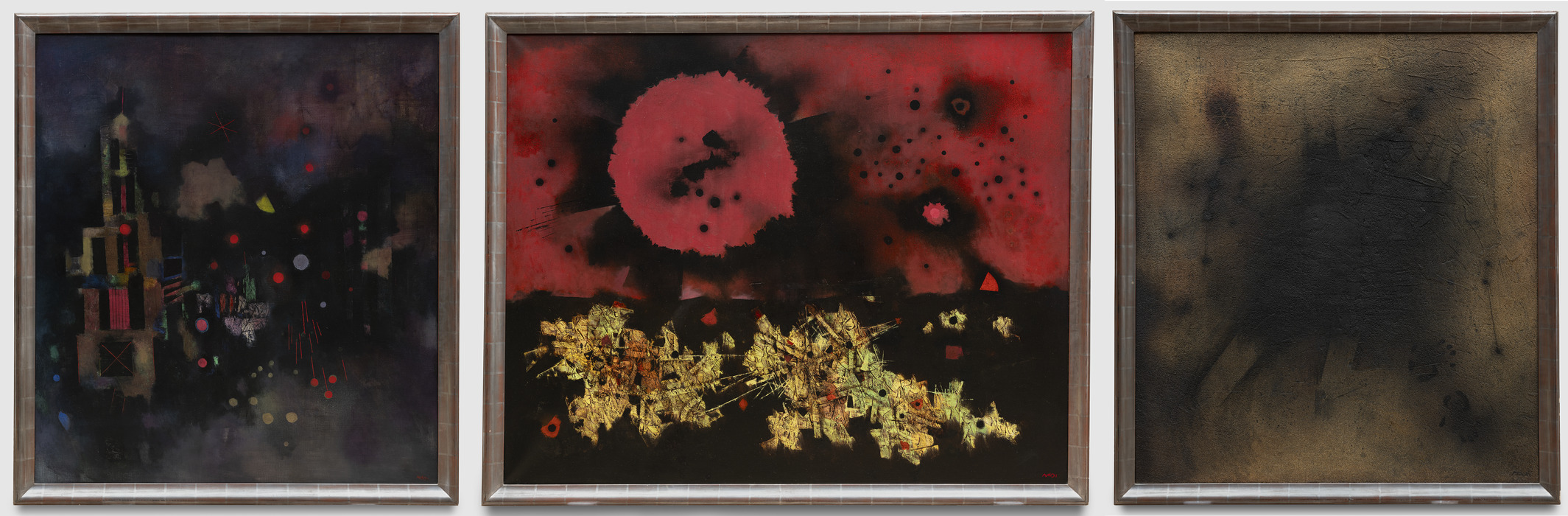
Mordecai Ardon, "Hiroshima – And there was Evening, and there was Morning (Hiroshima—Il fut soir, il fut matin)," 1988. Oil and egg tempera on canvas; Oil on canvas; Oil, sand, and acrylic binder on canvas, a: 51 1/8 × 45 3/4 in. (129.9 × 116.2 cm) b: 51 1/8 × 63 3/4 in. (129.9 × 161.9 cm) c: 51 1/8 × 45 3/4 in. (129.9 × 116.2 cm). The Jewish Museum, NY. Purchase: Gifts of Yoav Gottesman, Lauren and Mitchell Presser, Gil Brandes, and Ruth and Andrew Suzman.