New York Jewish Film Festival 1992
The Jewish Museum and The Film Society of Lincoln Center present Reemergence: Jewish Life in Eastern Europe, a new International Film Festival.
Certainly the films presented in Reemergence: Jewish Life in Eastern Europe signal the beginning of a previously unimaginable new chapter in that anthology of possible histories which Yosef Hayim Yershalmi describes. Seven of the eleven films were made during the revolutions of 1989-90. Given the suppression of explicit Jewish themes throughout the Communist period, the three earlier films either suffered from restricted availability (The Distant Journey) or treated their Jewish subjects and characters metaphorically (Daniel Takes a Train, Forbidden Dreams), perhaps as a sort of camouflage.
What is striking about seeing these and the many other films I screened during two trips over the last year and a half is the sense of coming upon newly excavated pieces of post-war history. Sitting in Moscow, Budapest or Prague watching hours of film over one or two weeks served as a kind of crash course in the long history of each country. It is readily apparent, as Tony Judt and Jim Hoberman remark in their essays here, how film has played a particularly central role in the life and politics of the former eastern bloc countries.
Films, like histories, are narrative stories, constructed by people to articulate the past. The terms in which a particular film or history is framed are always inflected by the pressing issues of the day. Indeed, the past one chooses has everything to do with the present and notions of the forseeable future.
Travelling in Czechoslovakia, Hungary, Germany and the former USSR in 1990 was an extraordinary experience — a bit like being at the center of a historical hurricane of indeterminate duration. The changes were enormous. People seemed to feel both a sense of euphoria about the unprecedented opportunity to literally remake entire societies, and simultaneously to realize what a wrenching process it is to change not just decades, but centuries, of inherited experience.
One wants to say, don’t revive all the old feuds, don’t rehearse all that again, choose a different set of paths, a genuinely “new order.” And further, do construct revised pasts which face up to all that was pathetic and crippling — but don’t exclude those instances of the sublime which European culture has also generated — the music of Bartok, the writings of Kafka or the poems of Anna Akhmatova.
As we watch this almost unbelievable Movie of late twentieth century history play itself out in those places from which so many of us trace our ancestry, it is our hope that the presentation and discussion of these films can contribute to the task of rememberance and reconstruction.
Wanda Bershen
Director, National Jewish Archive of Broadcasting
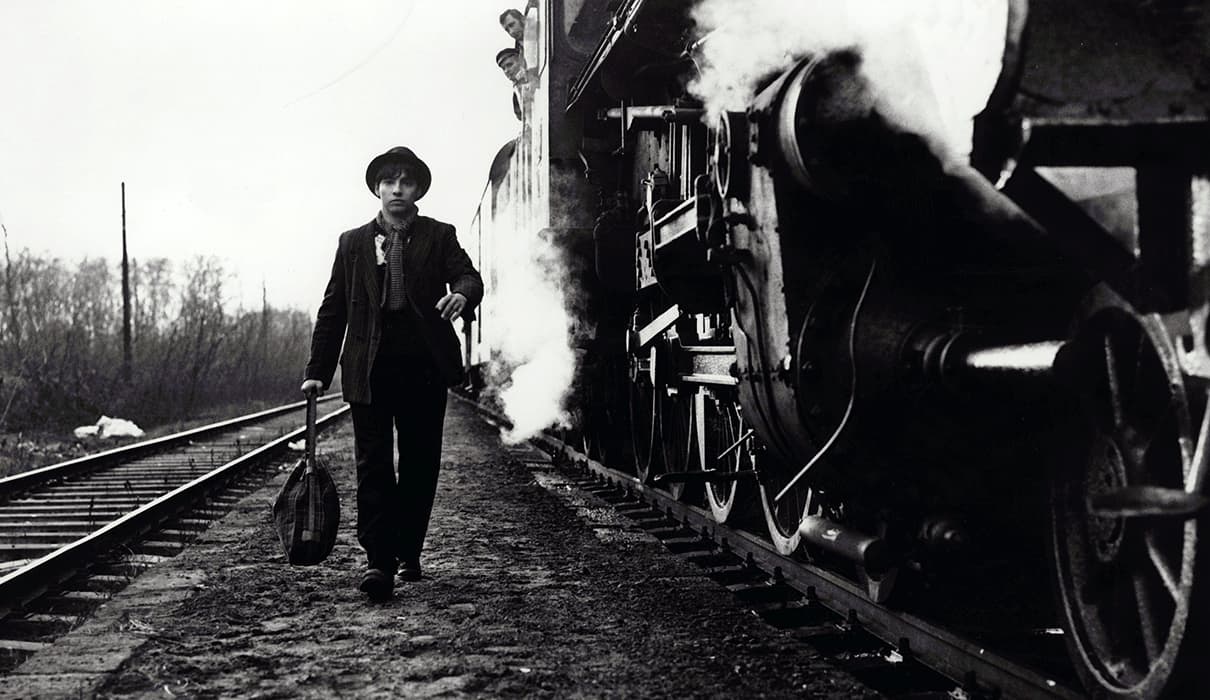
Still from Daniel Takes a Train, Pal Sandor, 1983. Hungarofilm / The Kobal Collection