Still More Distant Journeys: The Artistic Emigrations of Lasar Segall
The first major retrospective for the works of Lasar Segall in the United States. Celebrated in South America, Segall emigrated to Brazil, where he lived and worked until his death. The artist was born in Vilna, Lithuania, he lived in Berlin and Dresden, where he came to be associated with the German Expressionist movement.
“Oh, at full moon the wise men of the town again slip off to their quiet ghetto to join in fervent prayer for the still more distant journeys through the hostile night.”
So wrote the expressionist poet and critic Theodor Däubler when he introduced Lasar Segall in the 1920 Jewish Library, a series of books dedicated to making Jewish artists and poets known to a broad audience. Däubler called forth imagery of the cosmos, community, and travel and took these issues to be central to Segall’s work. Likening the ability of the Jews to change country and condition with the moon’s apparent ability to alter its size and shape, he proposed their migrations as part of an age-old, essential “racial character.” Since his first introduction, then, Segall and his work have been associated with the themes of unlimited physical and psychological horizons and a strong attachment to natural elements like the earth and sky.
These themes preoccupied the artist throughout his career. Segall exhibited a rare ability to move easily between various locations and integrate himself into new cultures. His paintings, drawings, and prints often dramatize his search for a place within an adopted culture: they are visual analogues to his personal experiences of identity and travel and are the site of his artistic emigrations.
Normally, the concept of emigration is limited to physical location. For Segall, however, it encompasses not just geographic or national distinctions but also a broader sense of community formed through social, economic, spiritual, or sexual commonalties among individuals. During his lifetime, Segall integrated himself into various religious, artistic, geographic, and human communities. Though they are sequential, his major “emigrations” overlap, one identity moving to the foreground while another recedes into not so distant memory. In a literal geographic emigration, one relinquishes one’s former identity to become part of a new country by adopting its cultural signifiers–the icons, anthems, and beliefs that unite a nation. Segall’s relocations are reflected in his artistic transformations of subject matter, style, and media as literal means of position, identification, and projection.
The Paintings of Chaim Soutine is made possible with generous support from The Florence Gould Foundation, Andrea and Charles Bronfman, Credit Lyonnais, the New York State Council on the Arts, the National Endowment for the Arts, the Louis and Anne Abrons Foundation, Inc., and the Joseph Alexander Foundation. The catalogue is published with the aid of a publications fund established by The Dorot Foundation, and the assistance of the Robert Lehman Foundation, Inc.
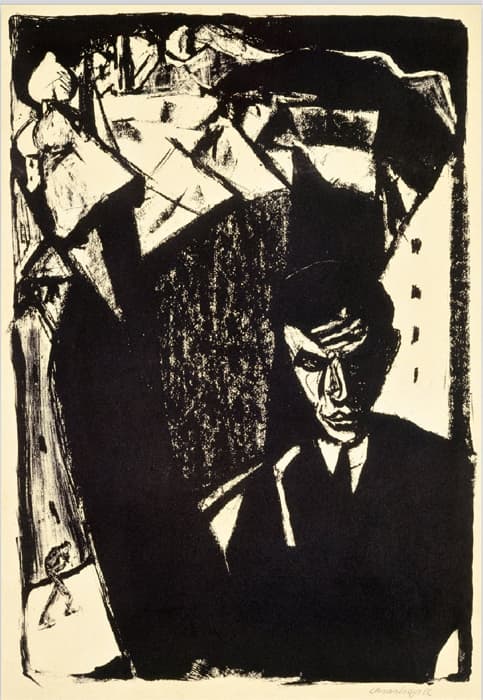
Vilnius and l, 1910 by Lasar Segall.